Case study
Sustainable blow molding through smart downstream automation
Sustainability is more than a claim at Califia Farms. It shapes how the company sources, produces,
and distributes its plant-based beverages. With ingredients sourced close to its facility, one question
became increasingly urgent as volumes grew: if raw materials are local, why transport millions of
empty bottles across the country?
By moving from pre-blown bottles to in-house blow molding, Califia took its sustainability strategy to
the next level. But producing bottles on site at high speed requires more than a blow molder alone.
It demands downstream automation that keeps bottle flow stable, efficient, and fully aligned with
filling operations. That’s where Delta Engineering came in.
Summary
• Challenge:
Transitioning from shipping in pre-blown bottles to in-house blow molding.
- Solution:
Delta Engineering developed a fully integrated downstream solution to the KHS blow
molder, including:
o Blow molder take-outs
o Chain conveyors
o Chain conveyor buffer
o Line controllers
o Vacuum pumps
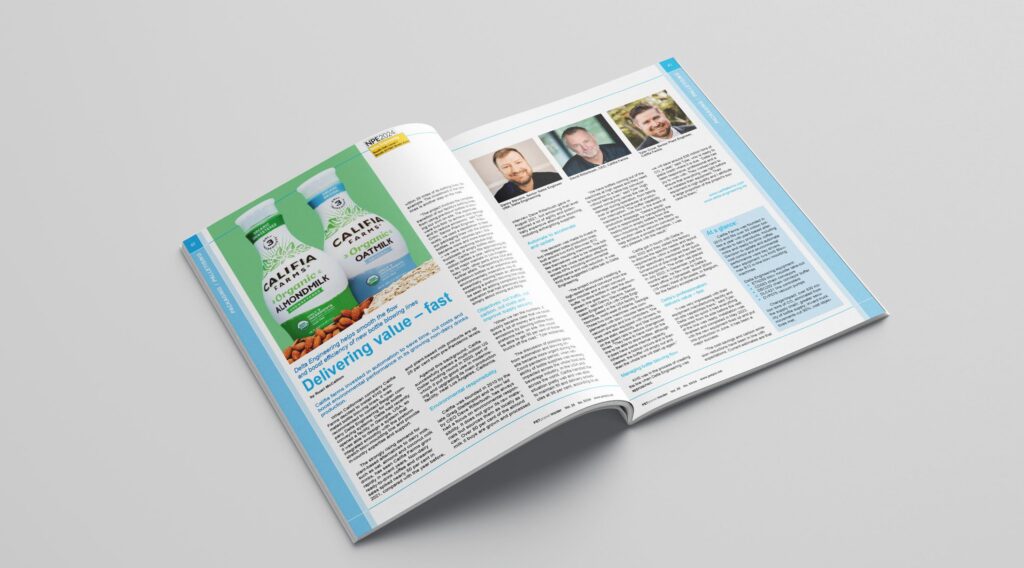
Founded in 2010, Califia Farms is a leading US producer of plant-based beverages, including
almond milk, oat milk, coconut milk, creamers, and ready-to-drink coffee. Headquartered in
California, the company fills close to 60 million bottles annually and distributes across major
US markets.
With sustainability embedded in its DNA, Califia sources over 80% of its almonds within 20
miles of its production site. As demand for non-dairy beverages surged, the company
invested in modernizing its main production facility near Los Angeles to increase capacity,
improve cost control, and further reduce its environmental footprint.
1. Challenge
Transitioning from pre-blown bottles to in-house blow molding
As production volumes grew, Califia relied on truckloads of pre-blown PET bottles
delivered weekly. This model became costly, inefficient, and environmentally unsustainable.
Transporting empty bottles meant moving air, not value.
By installing two high-speed inline stretch blow molding machines from KHS, Califia aimed
to eliminate up to 90% of inbound bottle transports. The business case was clear: lower
logistics costs, reduced emissions, and greater supply security
But producing bottles on site introduced new operational complexity. Lightweight PET
bottles exit the blow molder at high speed and must transition seamlessly to the filling line.
Any instability — tipping, jamming, static buildup, or downstream stoppages — can
compromise overall line efficiency. Califia needed a downstream conveying and buffering
solution capable of protecting uptime while matching the speed of the new blow molding
lines.
2. Solution
Integrated downstream automation for high-speed PET bottle lines
On recommendation of KHS, Califia contacted Delta Engineering to design and implement
the downstream bottle handling system. With its US facility in Norcross, Georgia, Delta
combined local expertise with global engineering know-how, Delta quickly translated
Califia’s production goals into a robust technical solution.
Delta engineered a fully integrated downstream solution including:
- Blow molder take-out systems
- Chain conveyors
- Chain conveyor buffer
- Line controllers
- Vacuum pumps
Rather than functioning as separate components, the system was engineered as one
coordinated flow path from blow molding to filling, ensuring control, stability, and
operational continuity at every stage.
3. Result
Stable high-speed bottle transfer
Freshly blown bottles are lightweight and sensitive to instability. Delta’s vacuum conveyor
technology ensures controlled transfer from blow molder to tabletop conveyor, preventing
tipping and reducing the risk of jams. The result is consistent bottle flow even at high output
speeds, a critical factor for maintaining overall equipment effectiveness (OEE).
Intelligent buffering for maximum uptime
Production interruptions happen. Delta’s integrated chain conveyor buffer creates
temporary bottle storage capacity, allowing the blow molding process to continue running
during short downstream stops. Once the issue is resolved, the buffer automatically clears
and restarts the flow smoothly. This buffering capability reduces stress on equipment, avoids
unnecessary shutdowns, and stabilizes production output.
Ionizers reduce static electricity, while ergonomic guard rail solutions minimize mechanical
adjustments during format changes. For production managers, this translates into shorter
changeover times, improved flexibility, and increased line availability, without compromising
stability.
Significant cost and CO₂ reduction
Blowing bottles in-house significantly reduced inbound truck movements, cutting transport
movements by approximately 90%. The environmental impact is substantial. Califia estimates
annual CO₂ savings of approximately 838 million tons across the supply chain. Combined with lower logistics costs and improved supply security, the investment value is clear.
Downstream automation that delivers measurable results
For Califia Farms, investing in in-house blow molding was about more than equipment. It
required a downstream automation partner capable of managing high-speed PET bottle flow,
buffering intelligently, and integrating seamlessly with existing filling operations.
Delta Engineering delivered a turnkey conveying and buffering solution that supports
production efficiency, reduces operational risk, lowers carbon footprint, and safeguards
supply continuity.
For beverage manufacturers looking to modernize PET bottle production, the message is
straightforward: high-speed blow molding only performs at its best when downstream
automation is engineered to match.
Ready to optimize your bottle handling and improve line
performance?
Delta Engineering is ready to help.
 Cookie policy